

Are you tired of dealing with hard water problems like spots on your dishes, dry skin, or clogged pipes? Choosing the right water softener size is the key to solving these issues once and for all.
But how do you know what size water softener you really need? Getting it wrong can mean wasted money or poor performance. You’ll discover simple steps to find the perfect fit for your home and water usage. Keep reading, and you’ll soon have the clear answers you need to make a smart, confident choice.

Credit: www.frizzlife.com
Factors Affecting Size
Choosing the right size water softener is important for good water quality. Several factors help decide the best size for your home.
Understanding these factors can save money and ensure the softener works well.
Water Hardness Levels
Water hardness shows how much calcium and magnesium are in your water. Harder water needs a bigger softener to treat it properly.
You can measure hardness in grains per gallon (gpg). The higher the number, the larger your softener should be.
- Soft water: 0-3.5 gpg
- Moderate hardness: 3.5-7 gpg
- Hard water: 7-10.5 gpg
- Very hard water: over 10.5 gpg
Household Water Usage
How much water your family uses affects the softener size. More water means you need a bigger system.
Calculate daily water use by multiplying people in your home by average use per person.
- Average use per person: 75 gallons per day
- Example: 4 people x 75 gallons = 300 gallons daily use
Number Of Bathrooms And Appliances
More bathrooms and water appliances increase water use and demand. This needs a larger softener to keep up.
Appliances like dishwashers and washing machines use water daily and should be counted.
- Each bathroom adds to total water use
- Water-using appliances add to demand
- More bathrooms and appliances need bigger softener capacity

Credit: www.frizzlife.com
Calculating Water Hardness
Understanding your water hardness is key to selecting the right water softener. This involves measuring the mineral content in your water supply.
Hard water contains high levels of calcium and magnesium. Knowing these levels helps you choose the correct softener size.
Testing Your Water Supply
Testing your water supply is the first step. You can use a home test kit or send a sample to a lab.
- Home test kits provide quick results.
- Lab tests offer more detailed information.
- Both methods measure calcium and magnesium levels.
Interpreting Hardness Results
Once you have your results, you need to interpret them. This will guide your decision on the water softener size.
| Hardness Level (GPG) | Water Type |
| 0-3 | Soft |
| 4-7 | Moderately Hard |
| 8-14 | Hard |
| 15+ | Very Hard |
The table above helps you understand your water's hardness level. GPG stands for grains per gallon, a common measurement for water hardness.
Estimating Daily Water Use
To pick the right water softener size, you need to know how much water your home uses daily. Estimating daily water use helps you avoid buying a unit that is too small or too big.
Daily water use depends on the number of people in your home and how much water each person uses. Other factors include your lifestyle and the appliances you have.
Average Consumption Per Person
On average, one person uses about 80 to 100 gallons of water per day. This includes drinking, cooking, cleaning, and bathing.
Multiply this number by the total people in your home to get a basic estimate of daily water use.
- 1 person: 80-100 gallons
- 2 people: 160-200 gallons
- 3 people: 240-300 gallons
- 4 people: 320-400 gallons
Adjusting For Lifestyle And Appliances
Some lifestyles use more water than others. For example, if you often fill a pool or water a large garden, your use will be higher.
Appliances like dishwashers, washing machines, and water heaters also affect daily water use. Newer appliances may use less water than older models.
- Large garden or pool increases water use
- Older appliances may use more water
- Frequent laundry or dishwashing raises daily use
- Conserving habits can reduce water use
Credit: qualitywatertreatment.com
Matching Softener Capacity
Choosing the right size water softener helps protect your plumbing and appliances. A softener that matches your water use and hardness works best.
Two main factors affect softener size: grain capacity and regeneration frequency. Understanding these helps you pick the right softener.
Understanding Grain Capacity
Grain capacity shows how many grains of hardness a softener can remove before recharging. It depends on water hardness and daily water use.
| Grain Capacity | Softener Size | Daily Water Use |
| 15,000 grains | Small | Up to 50 gallons |
| 30,000 grains | Medium | 50 to 100 gallons |
| 45,000 grains | Large | 100 to 150 gallons |
| 60,000 grains | Extra Large | 150+ gallons |
Choosing Regeneration Frequency
Regeneration frequency is how often the softener cleans itself. It depends on grain capacity and water hardness.
- More frequent regeneration uses more salt and water.
- Less frequent regeneration can cause hard water buildup.
- Most systems regenerate every 3 to 7 days.
- Choose a frequency that fits your water use and hardness.
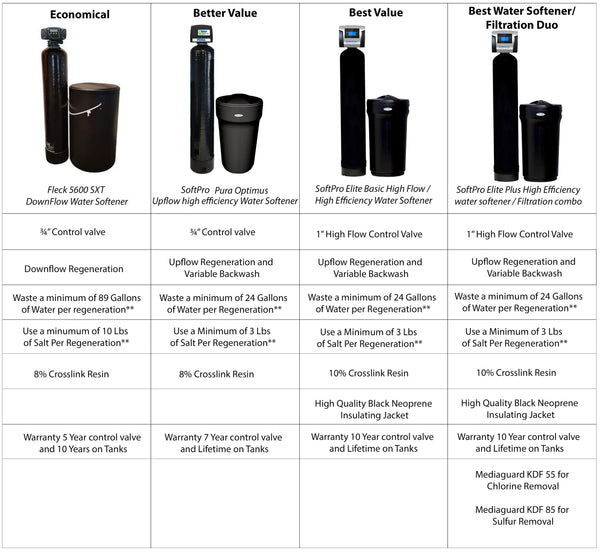
Types Of Water Softeners
Choosing the right water softener depends on your water type and household needs. Different systems use various methods to reduce hardness.
Understanding the main types helps you pick the best one for your home and budget.
Salt-based Systems
Salt-based water softeners use salt to remove hardness minerals like calcium and magnesium. They work by exchanging these minerals with sodium ions.
- Effective for very hard water
- Requires regular salt refilling
- Needs drainage for wastewater
- Improves soap lather and appliance life
Salt-free Alternatives
Salt-free systems condition water without adding sodium. They use different methods to prevent scale buildup.
| Feature | Salt-Based | Salt-Free |
| Removes hardness minerals | Yes | No |
| Prevents scale buildup | Yes | Yes |
| Requires salt | Yes | No |
| Maintenance needed | Medium | Low |
| Water discharge | Yes | No |
Magnetic And Electronic Options
Magnetic and electronic water conditioners change how minerals behave in water. They do not remove hardness but reduce scale buildup.
- Easy to install on pipes
- No salt or chemicals needed
- Uses electromagnetic fields or electric pulses
- Works best for mild to moderate hardness
Installation And Maintenance
Choosing the right size water softener is important for smooth installation and easy upkeep. Proper size affects how well it works and how often you need to maintain it.
This guide helps you understand space needs and routine care for your water softener system.
Space Requirements
Your water softener needs enough room for installation and future maintenance. Check the available space before buying.
Allow space for pipes, electrical connections, and easy access to the unit. This helps during repairs or refilling salt.
- Measure height, width, and depth of the unit.
- Leave at least 6 inches around it for airflow and service.
- Check for nearby water and power sources.
- Ensure the floor is level and strong enough to hold the system.
Routine Care Tips
Regular maintenance keeps your water softener working well. Follow simple steps to avoid problems.
Check the salt level often and add more when low. Clean the brine tank yearly to remove build-up.
- Use salt designed for water softeners.
- Inspect for leaks or damage every few months.
- Clean resin beads every 2-3 years if water hardness is very high.
- Reset the system after power outages or service.
Common Sizing Mistakes
Choosing the right size water softener is key for your home's water quality. Many people make errors that affect performance and cost.
Understanding common sizing mistakes helps you pick the best system for your needs. Two main mistakes are oversizing and undersizing.
Oversizing Issues
Buying a larger water softener than needed can waste money and cause other problems. A big system uses more salt and water than necessary.
- Higher upfront cost with no added benefits
- Increased salt and water use during regeneration
- More space needed for installation
- Possible shorter lifespan due to less frequent regeneration
Oversized systems may regenerate too often or not enough, reducing efficiency and increasing expenses.
Undersizing Consequences
A water softener that is too small will struggle to treat all your water. This leads to hard water issues like scale buildup.
| Problem | Effect |
| Insufficient softening capacity | Hard water damage to pipes and appliances |
| Frequent regeneration | More salt and water used than needed |
| Shorter system life | More repairs and replacements |
| Inconsistent water quality | Unpleasant taste and feel |
Cost Considerations
Choosing the right size water softener affects your budget. Cost matters both at the start and over time.
This guide covers the main cost parts to help you decide the best size for your needs.
Initial Investment
The initial cost includes buying the unit and installation. Bigger softeners usually cost more.
- Purchase price depends on capacity and brand
- Installation costs vary by plumber and location
- Extra parts or plumbing changes can add to the price
- Some models need special setup or space
Long-term Savings
A good size softener saves money by reducing maintenance and energy use. It also extends appliance life.
| Cost Factor | Small Softener | Large Softener |
| Salt Consumption | Lower | Higher |
| Water Use for Regeneration | Less | More |
| Frequency of Refills | More often | Less often |
| Energy Cost | Lower | Higher |
Frequently Asked Questions
How Do I Calculate The Size Of A Water Softener?
To calculate water softener size, consider household water usage and hardness level. Multiply daily water use by grains per gallon hardness. This helps determine the grain capacity needed for effective softening. Proper sizing ensures efficient performance and longer system life.
What Household Factors Affect Water Softener Size?
Household size, water hardness, and daily water consumption affect sizing. More people and harder water require larger capacity softeners. Also, consider peak water usage times to ensure the system meets your household needs without frequent regeneration.
How Often Should A Water Softener Regenerate?
Regeneration frequency depends on water hardness and system capacity. Typically, softeners regenerate every 2-3 days. Proper sizing reduces regeneration frequency, saving salt and water. Regular regeneration keeps the system efficient and extends its lifespan.
Can A Small Water Softener Handle A Large Family?
A small softener may struggle with large family needs. It can lead to frequent regeneration and insufficient softening. Opt for a larger capacity system to handle high water usage and hardness for optimal performance.
Conclusion
Choosing the right water softener size matters a lot for your home. Know your water hardness and daily water use first. This helps avoid buying a unit that is too big or small. A correctly sized softener saves money and works well.
Take your time to measure and calculate. Ask a professional if you feel unsure. Good water softening means cleaner pipes and softer skin. Remember, the right size keeps your water soft all year. Simple steps lead to better water every day.